# WingRiders introduction

<picture><source srcset="/files/gJEOYw3uWhR5UJdeazv0" media="(prefers-color-scheme: dark)"><img src="/files/qd0VKviDWhsvv6lkewfa" alt=""></picture>

Decentralized exchanges based on automated market makers (AMM) have become the standard and the most convenient way to exchange crypto tokens. The majority of these DEXes were built on top of account-based blockchains like Ethereum, of which the flagship is Uniswap. Cardano’s eUTxO model brings exciting benefits that address some of the shortcomings of DEXes on other blockchains with consistent fees and formally verified deterministic behavior.

WingRiders is a decentralized exchange ecosystem based on AMM that builds on top of the solid foundations of the Cardano network. Our goal is to create a trusted platform that enables users to exchange native Cardano tokens in a truly decentralized fashion with no intermediaries or single points of failure.

We aim at a modular approach to support as many wallets and other decentralized applications as possible. Our target is to become an infrastructure solution that enables and augments other projects as well.

From the beginning, we have defined and followed our stepping stones and values when building this product. The guarantees that WingRiders is committed to providing include:

* **Affordability** - Cardano fees are much smaller than on other ecosystems like Ethereum.
* **Anonymity** - Anyone with ADA can interact with the WingRiders smart contract. We impose no other requirements to be as anonymous as Cardano is.
* **Reliability** - Anyone whose order was not fulfilled by the deadline specified in the request can easily reclaim it.
* **Security** - The code is thoroughly audited, and its critical parts will be open source.
* **Simplicity** - The development team and designers have gone through many iterations and collected lots of feedback to ensure the WingRiders platform is easy to use and user-friendly.
* **Trust** - Nobody has a higher priority, and everyone is equal. Anyone can verify that requests were fulfilled in the order they were submitted onto the Cardano blockchain.


# Liquidity pools

There are two major types of DEXes - order book and AMM (Automated Market Maker). All AMM DEXes, including WingRiders, have liquidity pools where a function determines the exchange rate between the assets.

There are two commonly used functions for pools with two assets: a Constant product market maker and a Stableswap one.&#x20;


# Constant Product

### Formula

The constant product function is based on the following equation.

$$
x \* y = k
$$

The `x` here represents the amount of one asset, and `y` is the amount of the other asset. As the name of the functions hints, the principle is that the product of the asset amounts remains constant - the `k` in the formula. So if you want to swap asset one for asset two, `x` will increase, and `y` will decrease so that `k` is kept constant.

Constant product AMM is suitable for volatile token pairs because they enable trading at all possible prices. That means it can facilitate trading even during market fluctuation. It is also beneficial for primary markets, where traders are more likely to guess and act based on information from outside the market, despite higher slippage.

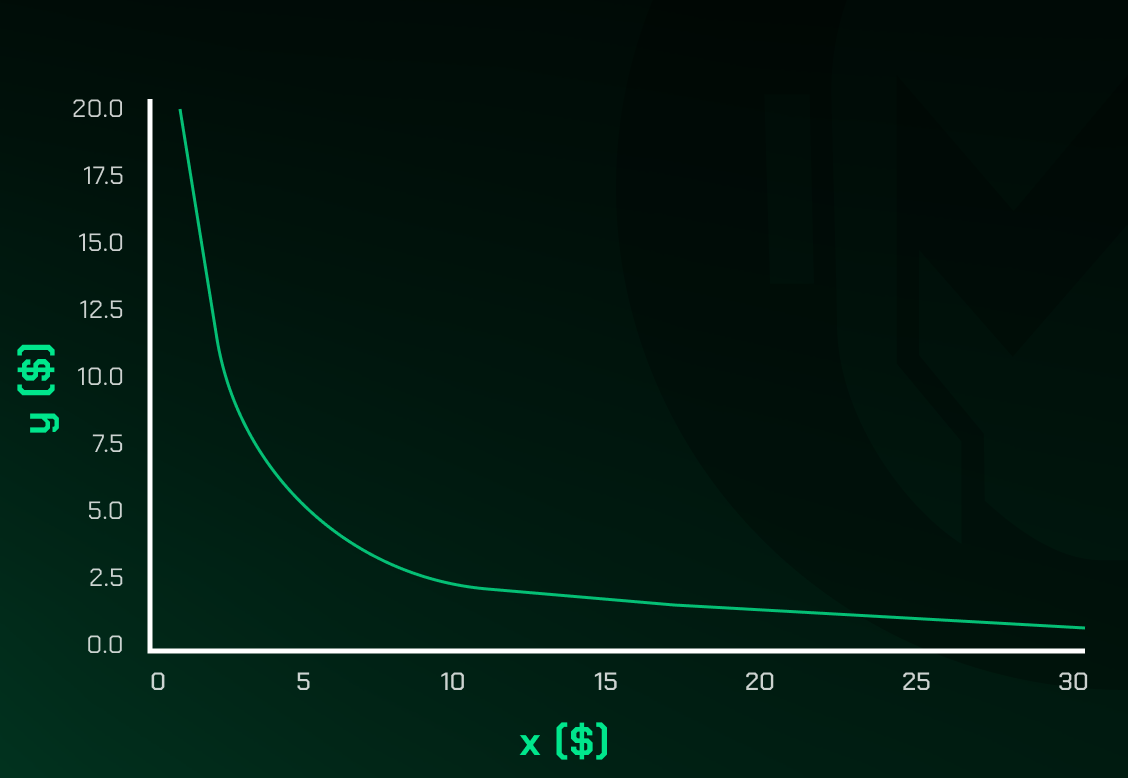
Following is the resulting price curve of the constant product AMM function. As you can see, large trades relative to the size of the pool move prices further along the curve in both directions. It is an elegant solution well-suited to most crypto assets that behave more like traditional stocks.

<figure><img src="https://lh3.googleusercontent.com/nQjUQgXHCgAQezNi3wlVUOfzlO3u7C8oChxzKjHZmIeLKGKvpU2lGhpgDBky6yPCJqioRDEOBOnin87vs--Odz50YY2uoROHItuGHjdSZuUgxpLWxFntzEI3O38YAwwhujDX8BCkrUXSRSKLSscdx9-rKYo2SWz2HNjQkc-Od-a-hm3GgY7OYTYvTtq5oA" alt=""><figcaption></figcaption></figure>

However, while the constant product market maker model is a great leap forward for DeFi, it is not ideal for trading pairs of USD stablecoins or any other two same-valued assets. For such trading pairs, it is desirable to exchange in a 1:1 ratio between them. In a constant product AMM world, it requires high liquidity to ensure low slippage, and even then, it can fall short of the set expectations.

This is where [Stableswap](https://docs.wingriders.com/liquidity-pools/stableswap) comes in.

### Constant Product Zap-in Functionality

To provide a better user experience we allow providing liquidity only in one of the assets. Under the hood, the pool performs a swap of some of the provided tokens to get the value balanced before performing a liquidity addition. The swap fee is still paid from this swap, but both the swap and the add liquidity happen in the same transaction, allowing the user to save on one agent fee.

### Constant Product Zap-out Functionality

It is likewise possible to remove liquidity in only one of the assets instead of withdrawing it in the ratio of the pool's balance. Mathematically it is equivalent to withdrawing the liquidity in the pool's ratio, and then immediately swapping all of one of the tokens for the second one. Similarly to the zap-in functionality, the swap fee is still paid from the swap, but the agent & TX fees are only paid once.

<br>


# Stableswap

Stableswap is an automated market maker (AMM) function focused on swapping between two stable assets with minimal slippage and more efficient trading for liquidity providers. The concept was pioneered by Michael Egorov, founder of Curve Finance, in a whitepaper published in late 2019, and this has majorly impacted the DeFi ecosystems.

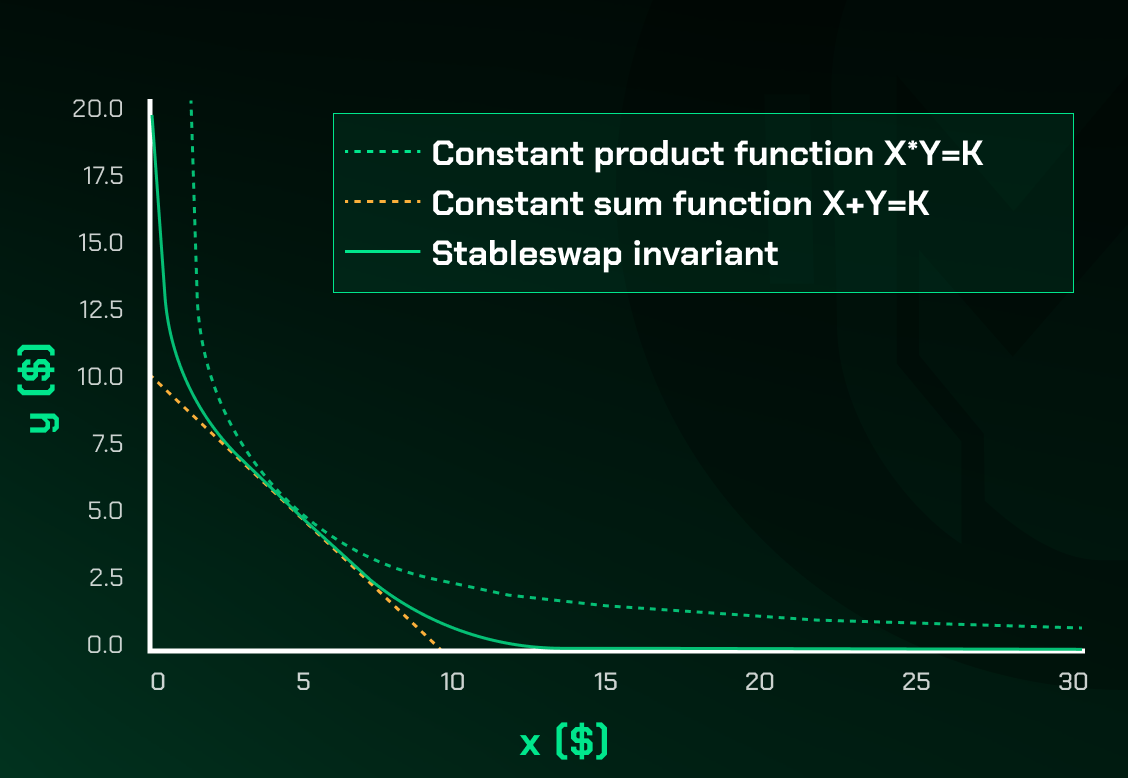
As you can see on the graph below, Stableswap is the middle ground between the two functions. The constant product described [here](https://docs.wingriders.com/liquidity-pools/constant-product), and the constant sum function, x + y = k. The latter means the exchange rate between the assets, or price, is always constant, hence the name. Even though it has practically zero slippage, it's not ideal, as the pool can run out of tokens or become significantly unbalanced. Stableswap invariant is a more complex function optimized for minimal slippage and a flatter curve around the optimal peg range. That results in mostly keeping the desirable 1:1 exchange ratio, better efficiency with big trades, and benefiting traders and liquidity providers.

<figure><img src="https://lh5.googleusercontent.com/FXWzEnTJF2C1Sb5rqdMVPrh8MPYO8CMGk_TJeE-VJlOyTQqbVuSe9sumv4MZztLuUQiBBGTN0zJBcMp9rhFn1v3XfD3w0JgK6BbBsoUSGyUVUydr1aYIQZlZvx49teUGx8N4Ne7EhsAfKwSq8-2dSbG8X2LgyzT3PcV-REdaAjzlMmrVJnHNpjO1_cdA0Q" alt=""><figcaption></figcaption></figure>

### Implementation of Stableswap

We implemented Stableswap V1 on top of our existing audited V1 contracts. They have been in production since our mainnet launch and make a perfect foundation for this. We kept all the trusted and secure parts and only changed the AMM function used in the contracts to the Stableswap invariant. That enabled us to speed up our development and make relatively few and easily auditable changes.&#x20;

With migrating to V2 contracts rewritten from scratch in Plutarch, Constant product and Stableswap pools continue to share the same codebase and only differ in the invariant formula. This new V2 codebase has been thoroughly audited as well with the audit results made publicly available.

If you want to dive deeper into the mathematics behind it, check out the [Stableswap whitepaper](https://classic.curve.fi/files/stableswap-paper.pdf).

### Why is Stableswap necessary?

A common problem when swapping tokens via standard constant product function AMM DEX is that trades between one pegged asset and another are seldom as efficient as they could be. Now, with the new WingRiders Stableswap pools, the advantages are clear:

* Traders can swap between stablecoin (pegged) assets with minimal possible slippage and price impact.
* Liquidity providers can use Stableswap pools, which dramatically reduce the risks associated with impermanent loss and could lead to benefits resulting in deeper liquidity, higher volumes, and an overall larger pool of fees from which liquidity providers benefit. It's important to note this is only true until the stablecoins maintain their peg.

In crypto, stablecoins are a crucial part of the ecosystem. As we have seen on other blockchains, Stableswap pools are a critical foundation to help other DeFi projects, such as borrowing and lending, grow even more. On Cardano, we hope to continue our mission to be a key infrastructure component for all the other projects building out there.

### Stableswap Zap-in functionality

To provide the best possible user experience, we want to allow liquidity providers to provide liquidity for Stableswap pools with any ratio of tokens they have in their wallet (including using only one of the tokens in the pool). This mechanism performs a swap on the pool before adding liquidity in the same ratio as the pool after the swap. The swap fee is still paid from this swap, however, both swap and add liquidity happen in one transaction only, therefore saving you one transaction fee and batcher fee. This also allows us to more easily balance the pool by adding liquidity, which is beneficial for the traders as it facilitates bigger possible swaps. When adding liquidity to the balanced pool, you are getting more Liquidity Provider Tokens (LPTs). Therefore we have added new transaction settings for adding liquidity to Stableswap pools that allow you to automatically calculate the pool balance.

### Stableswap Zap-out functionality

It is also possible to remove liquidity in only one of the assets instead of withdrawing it in the ratio of the pool's balance. Mathematically it is equivalent to withdrawing the liquidity in the pool's ratio, and then immediately swapping all of one of the tokens for the second one. Similarly to the zap-in functionality, the swap fee is still paid from the swap, but the agent & TX fees are only paid once.

#### How is the Stableswap pool balance calculated?

Since Stableswap pools by definition have both assets representing the same value (USD, BTC, ETH, etc.), the balance happens when both tokens are in the pool in a 1:1 ratio. Let's assume we have a Stableswap liquidity pool iUSD/DJED with current values of 60,000 iUSD and 120,000 DJED, so a 1:2 ratio, and let's have a look at what would happen in the following scenarios:

* The liquidity provider wants to provide 60,000 iUSD to this pool, therefore he enables zap-in. Since our pool has more DJED tokens than iUSD, our auto-balance will calculate that 0 DJED needs to be added as well to perform an efficient zap-in. Then the smart contract will first take 29,971.78 iUSD and swap those for 30,028.21 DJED (swap fee is paid to the pool) balancing the pool to better balance and afterward adding liquidity in the same ratio of 120,000 iUSD and 120,000 DJED. He receives LPTs which can be redeemed at that moment for 30,028.21 iUSD and 30,028.21 DJED. This means with this efficient Zap-in, our liquidity provider effectively gained 56.42 USD stablecoin value.
* The liquidity provider wants to provide 60,000 DJED, therefore he chooses a zap-in. If he has some iUSD in his wallet, the auto-balancing function will calculate that he should provide 120,000 iUSD to balance the pool and get the most possible LPTs from this transaction. Unfortunately, he does not want to provide any iUSD to the pool, so he disables it in the settings and specifies 0 iUSD. We will show a warning that this operation is inefficient and he will receive fewer LPTs so he should either wait for the balance to change or add some of the other currency. If he continues with the operation, the pool would be set to 60,000 iUSD and 180,000 DJED and he can redeem his LPTs for 14,966.80 iUSD and 44,900.41 DJED, effectively losing 132.78 USD stablecoin value.
* The liquidity provider wants to provide 20,000 iUSD and 40,000 DJED, which can be done with zap-in disabled. Since the liquidity is being added in the same ratio as the pool has, there will be no swap happening and new pool values would be 80,000 iUSD and 160,000 DJED. He receives LPTs which can be redeemed at that moment for 20,000 iUSD and 40,000 DJED, the same as he had in the first place.


# Actions

Individual [asset pairs](/glossary#asset-pair) are organized in [liquidity pools](/glossary#liquidity-pool). This means that users can not only swap their native tokens but can carry out actions like providing liquidity, creating new liquidity pools and more. In this section, we will define and explain all possible actions possible in the WingRiders [DEX](/glossary#dex).


# Creating a request

A user interacts with WingRiders' liquidity pools by creating a request. There are three types of requests:

* [Swap request](/actions/swapping)
* [Add liquidity request](/actions/adding-liquidity)
* [Remove liquidity request](/actions/removing-liquidity)

These requests will get fulfilled by an [Agent](/glossary#agent) and are therefore subject to an [Agent fee](/glossary#agent-fee). After a request is fulfilled, the desired outcome gets reflected in the user's wallet balance.

Other actions like [Creating a liquidity pool](/actions/creating-a-liquidity-pool) or [Reclaiming requests](/actions/reclaiming-requests) are done directly without the involvement of any agents.


# Swapping

Swaps represent a process where a user decides to exchange a selected amount of held Token A's for Token B's. The user states their intention by submitting a swap request, which gets fulfilled by an Agent interacting with the correct liquidity pool.

We prepared some basic "good-to-know tips" you should keep in mind before jumping into your first swap:

* **Slippage** - Before every swap, a tolerated slippage percentage of the exchange rate has to be specified. This is because there may be multiple requests waiting in the queue to get fulfilled. If these requests were queued sooner than the user's request, they will affect the final exchange rate by the time his request is carried out.
* **Request Oil ADA** - The Cardano network requires that every transaction output contains at least a small amount of ADA. To satisfy this requirement, a 2 ADA "deposit" called [Request Oil ADA](/glossary#request-oil-ada) needs to be included in the swap request. This amount is returned with the exchanged assets after finishing the transaction. In case a routed swap is used instead, oil ADA is increased to provide at least 2 ADA for each request in the swap chain.&#x20;
* **Swap Fee** - Every swap is subject to a [swap fee](/glossary#swap-fee). A swap fee is in place to ensure the smooth operation of WingRiders DEX and reward liquidity providers.
* **Agent Fee** - A swap request needs to be fulfilled by an [Agent](/glossary#agent), so an [agent fee](/glossary#agent-fee) is included. Currently, it's set at a very conservative value to cover any fees the Agent might have to pay when interacting with liquidity pools.
* **Deadline** - Swap requests have a limited validity interval and expire after a given deadline. The deadline represents how long a user is willing to commit to a swap with the given properties (slippage, exchange rate). It is both to protect the users as the requests might take time to fulfill and to not interfere with the Agents' interactions with the liquidity pools.

To sum things up, we will demonstrate a token swap in the following image:

![User creates a swap request interacting with a 1000 ADA : 2000 Token B pool](/files/goUBScoYxzH55BK5KY6j)

### Routed swaps

To facilitate more convenient exchanges between tokens with no direct pool available, the contracts support routing swaps that go through an intermediary pool. The web interface calculates the expected prices and proposes a set of possible routes prioritizing the most efficient ones. Keep in mind that a routed swap is equivalent to making two swaps, so the swap fee would be paid twice, once in the initial token -> intermediary token swap, and once in the intermediary token -> desired token swap. It's not possible to always guarantee a successful route execution, so it's possible the second request is not executed in case the price changes drastically.

## Guide

You can create a swap request under the **Swap** tab. After picking both assets, you can fill in either of the amount fields and the other one will be automatically calculated. At the same time, you will see the fee at the bottom being updated.&#x20;

![](/files/Ya7QgyM3gqPruBjPrG4f)

To access the **Transaction settings**, click the ⚙️ button. There you will find the option to adjust the slippage tolerance, unlock token ratio editing and deadline.

![](/files/UNk9WqXdsCAFMfBbiamm)

To see a more detailed breakdown of all the fees and assets, click the **Total fees** button.

![](/files/kDd7LWcOLbe1jW6YyWua)

Once you are ready, click **Swap**. WingRiders will let you once more review the transaction details. If you are satisfied with the transaction, confirm it using the **Confirm** button. Afterward, you will be prompted by your connected wallet to sign the transaction (*example from Nami Wallet, the interface may differ in other wallets*).

![](/files/mpXQ8NCVx2VV9zJBcg6F)![](/files/HolcROJfUhN6mSRq6NTt)

After a successful signature, WingRiders will inform you about a successful swap request submission. You can track the progress of your request in the **Transactions** tab, either by clicking **Transaction list** in the message window or clicking **Transactions** in the top right corner.![](/files/USdCxnUXEnMRzLlRUmAH)<img src="/files/Mkn4dotd15VNR78YPRgT" alt="" data-size="original">

After successful execution, you will see that swap listed in the **Completed** tab.

![](/files/b4gSFxNl0iRTYtC5El2r)


# Halting mechanism

To protect liquidity providers, if any of the stablecoins in WingRiders Stableswap or ADA/stablecoin pools fail (as a project, as tech, or have currency problems), resulting in de-pegging of the coin, all swapping within these pools on WingRiders is automatically halted to safeguard the portion of the other asset locked in that pool for its owners.

It is set that in the case of a 15% de-pegging of a stablecoin (e.g. for iUSD if the price is not between 0.85 and 1.15 USD), the halting mechanism automatically occurs on the transaction execution level (batcher). The withdrawal of Liquidity will always remain available.

<figure><img src="/files/JSq5L77USxzTLzwUJ8T1" alt=""><figcaption><p>Warning message about price de-peg detected</p></figcaption></figure>

### How the halting mechanism works

Our batcher always tries to apply transactions to the pools from oldest to newest until they expire. If it detects de-pegged stablecoin in Stableswap or ADA/stablecoin pools, it will skip swap and add liquidity transactions until the price recovers or the transaction expires. Prices of stablecoins are fetched using external API providers every 15 minutes. Users will be notified about this in the UI by having warning notifications next to their pending transactions and in the modals in the swap and adding liquidity. They can choose to reclaim their transactions.&#x20;

<figure><img src="/files/K4jeLrSLb9pMpNq7hUmT" alt=""><figcaption><p>Warning message about batching halted</p></figcaption></figure>

The de-pegging mechanism differs between Stableswap pools and ADA/stablecoin pools. Since the Stableswap pool model works great if the two tokens are roughly the same value, we halt trading and add liquidity if we detect a 15% difference in their price from external API. This means if for some reason both tokens de-pegg from their original value by the same margin (e.g. DJED would be 0.81 USD and iUSD would be 0.83 USD), we still process transactions as usual. However, the same de-pegg would halt transactions on the ADA pools of respective tokens (e.g. ADA/DJED, ADA/iUSD).


# Creating a liquidity pool

Anybody can create a [liquidity pool](/glossary#liquidity-pool). The only requirement is that the [asset pair](/glossary#asset-pair) does not already exist.

Liquidity pool creators are also [liquidity providers](/entities/liquidity-provider) since they deposit the initial liquidity and are given [LP tokens](/glossary#liquidity-provider-token) in return. For security reasons, a very small portion of the initial liquidity is locked in the liquidity pool forever. The liquidity provider needs to make sure that the ratio in which the initial liquidity was provided reflects the real-world exchange rate, otherwise, <mark style="color:orange;">it would be open to</mark> [<mark style="color:orange;">arbitrage</mark>](/glossary#arbitrage) and they could lose out on the overall value.

One thing to keep in mind is that the liquidity pool creator needs to provide a small amount of non-refundable ADA bundled with the tokens as <mark style="color:orange;">per the requirements</mark> of the Cardano blockchain.

The creation of a liquidity pool can be seen in the following image:

![User creates a new liquidity pool and receives LP tokens](/files/Mhgc3N4V1ZSJyEUC2YOc)

## Guide

You can create a liquidity pool in the **Pool** tab by clicking **Create pool**. This will take you to the **Create a new pool** page.

![](/files/7xndP63BPH5BkG4YXFch)

Here you have to select a pair of assets that do not have an existing liquidity pool yet.&#x20;

![](/files/dhsyxPOxwnozdS2iFyc2)

Once you are ready, click **Create a new Pool**. WingRiders will let you once more review the transaction details. If you are satisfied with the transaction, confirm it using the **Confirm** button. Afterward, you will be prompted by your connected wallet to sign the transaction (*example from Nami Wallet, the interface may differ in other wallets*).

![](/files/jOlGxe1IIaJsP8u7usjy)![](/files/nj4D61FODrnTJn9grpg7)

<mark style="color:orange;">After successfully signing the transaction</mark>, WingRiders will inform you about a successful pool submission. You can track the progress of the pool creation in the **Transactions** tab, either by clicking **Transaction list** in the message window or clicking **Transactions** in the top right corner. After the transaction is confirmed, you will see your transaction in the **Completed** tab.

![](/files/wrsIFyzmiMwPc9zrN6Xr)![](/files/c0OCPcwBiMTU28g2GUtB)


# Adding liquidity

In the process of adding liquidity, a user decides to deposit tokens to the [liquidity pool](/glossary#liquidity-pool). This helps to maintain better exchange rate stability (reduces slippage). As a result, he receives a portion of swap fees as a reward.

Liquidity providers receive [LP tokens](/glossary#liquidity-provider-token) (liquidity provider tokens) in return for locking in their tokens. These tokens represent the size of the provider's share in the liquidity pool and can be redeemed at any time for the deposited tokens. The value of individual LP tokens grows as [swap fees](/glossary#swap-fee) are accumulated in the [pool](/glossary#liquidity-pool) and the value is also impacted by an impermanent loss if the exchange rate changes significantly.

A good thing to keep in mind when adding liquidity is that the amount of received LP tokens is dependent on the ratio in which the liquidity is provided. The ratio is automatically calculated by the UI to provide liquidity providers with the maximum possible amount of LP tokens they are <mark style="color:orange;">eligible for.</mark> However, especially in the smaller pools, the asset ratio can significantly change and impact the number of received LP tokens. Therefore, liquidity providers can specify LP token slippage percentage in the Transaction settings to ensure that their requests won't get executed in case they would've received fewer tokens than they expected.

This can be also seen in the following image:

![Liquidity provider gets LP tokens for providing liquidity in correct ratio to 1000 ADA : 2000 Token B pool](/files/EM1zAnUmAs8kUlqfnGVq)

## Guide

You can find the option to add liquidity in the Pool tab. Here you can filter the desired pool using the provided filter text field.

![](/files/zkcn9LMfvtWNxwCoCOmE)

After clicking on the Add Liquidity button, a **Manage liquidity** form will appear. You want to have selected the Add liquidity option. Here you input one of the amounts. The other one will be automatically calculated based on the most recent exchange rate.

![](/files/uMoPV0BKapLWQPPohgPL)

To access the **Transaction settings**, click the ⚙️ button. There you will find the option to adjust the slippage tolerance and deadline.

![](/files/CDQIO5nWIoKI0kRwCoxs)

To see a more detailed breakdown of all the fees and assets, click the **Total fees** button.

![](/files/LDmh190ZtiOuhXlKLlSd)

Once you are ready, click **Add Liquidity**. WingRiders will let you once more review the transaction details. If you are satisfied with the transaction, confirm it using the **Confirm** button. Afterward, you will be prompted by your connected wallet to sign the transaction (*example from Nami Wallet, the interface may differ in other wallets*).

![](/files/dEytDkGcG5AZikm9NeTV)![](/files/PE9CRbDwgdBSuvlGjPUJ)

<mark style="color:orange;">After successfully signing the transaction</mark>, WingRiders will inform you about a successful add liquidity request submission. You can track the progress of your request in the **Transactions** tab, either by clicking **Transaction list** in the message window or clicking **Transactions** in the top right corner.

![](/files/h7YA0Wyi1EakaTYPuI4G)![](/files/o1GkiumB2JwwiKqM5bQy)

After successful execution, you will see that swap listed in the **Completed** tab.

![](/files/kvXLfvmMcfzF7b0oLz2I)


# Removing liquidity

Removing liquidity is a process of redeeming received [Liquidity Provider Tokens](/glossary#liquidity-provider-token) back into the deposited tokens. By doing this, the user receives back their portion of the tokens locked in the liquidity pool.

The value of LP tokens is impacted by several factors over the time the liquidity is locked in the pool:

1. By accumulated [swap fees](/glossary#swap-fee)
2. In the case of ADA/token pools also accumulated staking rewards
3. And lastly the change in the ratio of the [asset pair](/glossary#asset-pair)

That means that the liquidity provider removing his liquidity may receive tokens in a different ratio. Since WingRiders currently uses a constant-function market maker, similar to other DEXes, the value of the liquidity pool tokens is susceptible to [impermanent loss](https://academy.binance.com/en/articles/impermanent-loss-explained).

A simple example of a liquidity removal can be seen in the following image:

![A general example of a user redeeming his LP tokens](/files/ilRWx4BAC38ojunlV3gk)

## Guide

You can access the option to remove liquidity through the <mark style="color:orange;">Pool</mark> and Portfolio tabs. In the <mark style="color:orange;">Pool</mark> tab, you can filter the desired pool using the provided filter text field. In the Portfolio tab, you have listed only the pools you have liquidity in.

![](/files/peTxPnty7AFUVwsaMOMQ)

![](/files/IeSJZCX5mqxRfBr1vyk4)

After clicking on the **Deposit/Manage** button, a **Manage liquidity** form will appear. You want to have selected the Remove liquidity option. Here you can choose the percentage of your provided liquidity to remove.

![](/files/efHnVCtRFLXVhMpDRMLT)

To access the **Transaction settings**, click the ⚙️ button. There you will find the option to adjust the slippage tolerance and deadline.

![](/files/pBJOJE5WsDqoHrBjSx1U)

Once you are ready, click **Withdraw Liquidity**. WingRiders will let you once more review the transaction details. If you are satisfied with the transaction, confirm it using the **Confirm** button. Afterward, you will be prompted by your connected wallet to sign the transaction (*example from Nami Wallet, the interface may differ in other wallets*).

![](/files/2b4P6Iz0gJWBs7JX167e)

After a successful signature, WingRiders will inform you about a successful withdraw liquidity request submission. You can track the progress of your request in the **Transactions** tab, either by clicking **Transaction list** in the message window or clicking **Transactions** in the top right corner.

![](/files/iNbHQWeY25PvzfcnLTdG)<img src="/files/XPehFalal8HrvRXMqRiq" alt="" data-size="original">

After successful execution, you will see that swap listed in the **Completed** tab.

![](/files/BQsrInPM5F8jrIHzeaBQ)


# Reclaiming requests

Reclaiming is a process where a user withdraws a request that wasn't carried out before the specified deadline. There are multiple possible scenarios where the request might not get fulfilled, specifically:

* The acceptable [slippage](/glossary#slippage) was set too low when creating the request. [Agents](/glossary#agent) always respect the parameters set in the requests and if it's not possible to carry out a request given the parameters, <mark style="color:orange;">the request cannot be executed.</mark>
* User-specified `deadline` is short and expires too soon or the network is congested and the transaction is not accepted in time as a result.

Funds locked in requests are **always 100% safe** and can be easily reclaimed using the WingRiders UI after the deadline has expired.

## Guide

You can reclaim your requests in your list of **Pending transactions** in the **Transactions** tab.

![](/files/gM9beh3WAWFSWe6tlxkd)

After clicking on the **Reclaim** button, a **Confirm reclaim** window shows up, where you can review the reclaim. Once you are ready, click **Confirm**. Afterward, you will be prompted by your connected wallet to sign the transaction (*example from Nami Wallet, the interface may differ in other wallets*).

![](/files/lYAPV0ha5qmL5SvhinDT)![](/files/gbQwaWG3zProiBWzUVNA)

<mark style="color:orange;">After successfully signing the transaction</mark>, WingRiders will inform you about a successful reclaim request submission. You can track the progress of your request in the **Transactions** tab, either by clicking **Transaction list** in the message window or clicking **Transactions** in the top right corner. When confirmed, you will see the transaction in the **Completed tab** of the Transactions section.

![](/files/Nheeu8ocyYJJIFLmPo4G)![](/files/eE6I44LWkDbrQYpVsG5G)


# Staking

### What is staking?

Staking is an important mechanism in a Proof of Stake blockchain like Cardano to support the security and operations of the blockchain network. Staking is the act of delegating or locking up crypto holdings in exchange for rewards. ADA staking rewards offer a way to earn passive income from holding Cardano.

### What does staking on WingRiders mean?

Unlike similar platforms where staking is synonymous with yield farming, WingRiders divides these two terms for separate functionalities. Staking means you can stake ADA on Cardano. So by providing liquidity into Liquidity pools containing ADA, you are gaining additional rewards from ADA staking on the Cardano blockchain. These rewards accumulate over time and are redistributed back into the Liquidity pools.

### How does auto-staking work?

ADA locked inside a smart contract for the liquidity pools is automatically staked. The rewards from ADA delegation are automatically returned into the liquidity pools, increasing the value of the LP tokens owned by liquidity providers. This is a fully automated process - we have a staking agent controlled by the DAO. Delegation rewards for the whole pool are collected after one epoch and are added back into the given pool when the accumulated rewards are at least 4 ADA.

### What do I have to do?

If you provide liquidity you will be given a utility token, so-called Liquidity Provider Token or LP token, that functions as your receipt of the provided ADA. The ADA you provide will be staked automatically and rewards will be pushed back into the pool after a given period of time - defined as an “epoch”. The value of the LP tokens is then increased by the delegation rewards returned into the pool. The epoch is the typical time interval for ADA staking on the Cardano blockchain.

### Can I stake in ISPO pools?

Not yet. The current version only supports staking into pools which only give ADA rewards. ISPO pools make it difficult to determine and distribute their rewards to individual users. In the future, we will explore options to implement support for ISPO pools.

### Will I get the staking reward in my wallet?

Not directly. The staking rewards after the epoch first will go back into the Liquidity pool which will in turn increase the overall value that you can withdraw with your LP tokens.

### What pools do you support?

Staking of ADA is only relevant to ADA-to-Token pools. Other features in the DEX, like swapping, and farming support both Token-to-Token Liquidity pools and ADA-to-Token pools.&#x20;

### Can I split my LP tokens into multiple staking pools?

ADA staking is done per Liquidity pool. Every liquidity provider that contributes to an ADA Liquidity pool gets a chance to vote on which stake pool the whole liquidity will be delegated to. Each Liquidity pool can be delegated to a separate stake pool, but one Liquidity pool can only be delegated to a single stake pool. The DEX relies on the LP providers not to select a pool while voting, where they would oversubscribe with their delegation.


# Voting for Stake pools

There is a democratic process in place for liquidity providers to decide in which Stake pool the whole ADA amount in the Liquidity pool will be delegated.

## How voting works

There is a separate voting for each ADA Liquidity pool, which means that every ADA Liquidity pool on WingRiders can delegate its ADA to a different Stake pool. A single ADA Liquidity pool can be delegated to a single Stake pool.

Each Liquidity Provider Token is counted as a single vote. Users have to deposit their LP tokens if they want them to be used for voting. You can decide how many of your LP tokens you want to deposit - the more you deposit, the bigger your voting power will be. Keep in mind that deposited LP tokens are locked in a smart contract and they won't be available at your disposal until you withdraw them.

{% hint style="warning" %}
The deposited tokens are shared between farms and voting. See below.
{% endhint %}

At the end of each Cardano epoch, the voting results are summarized and ADA from the Liquidity pool is staked to the winning Stake pool in the next epoch.

## What is your voting power?

Your voting power is the **minimum** of your deposited LP tokens in a given epoch. What does this mean in practice? Let's say you deposit 100 of LP tokens for voting in the middle of epoch 335. Your minimum deposited LP tokens in epoch 335 will be 0, thus you will have no voting power in this epoch. If you keep your 100 LP tokens deposited, your minimum deposited LP tokens in epoch 336 will be 100, which means your voting power in epoch 336 will be 100 and you will have a chance to change where the ADA from the Liquidity pool will be delegated.

If you would have withdrawn your 100 LP tokens in epoch 336, your minimum deposited LP tokens in epoch 336 would drop to 0 and you would lose your voting power.

In case you've removed 20 LP tokens in epoch 336, your minimum deposited LP tokens and voting power would be 80 for the epoch.

To sum up, you have to keep your LP tokens deposed for **the whole epoch** to have voting power.

## Changing your preferred Stake pool

If you deposit your LP tokens and vote for a Stake pool but later decide to change the Stake pool you can easily do so in the application. In this step, you won't be able to change the number of deposited LP tokens, you can just change your preferred Stake pool.

In this scenario, your minimum deposited LP tokens in the current epoch **will not change** and your voting power in this epoch will be the same.

## Depositing your LP tokens to a farm vs using them for voting

Depositing your LP tokens to a farm and depositing them to vote is technically the same thing. We don't want users to lose on farming rewards if they want to vote for a Stake pool and vice versa.

This means that if you deposit your LP tokens to a farm you automatically gain the opportunity to use your deposited LP tokens for voting, you just need to select your preferred Stake pool (apply your vote).

{% hint style="danger" %}
Keep in mind that this goes both ways. If you withdraw your LP tokens from voting in a Liquidity pool that has a farm, you will lose your farming rewards.
{% endhint %}

## Minimum voting participation

For the voting results to change the Stake pool where ADA will be delegated, the voting participation must be **at least 15%**. This means that at least 15% of all issued LP tokens for the Liquidity pool have to participate in voting. If the participation drops below this minimum, the default stake pool will be selected again.


# How to vote

Voting for a Stake pool is a process where users deposit their [LP tokens](/glossary#liquidity-provider-token) in exchange for having the power to change which Stake pool will be ADA from a [Liquidity pool](/glossary#liquidity-pool) delegated to. Before voting, we highly recommend reading about [how voting for Stake pools works](https://docs.wingriders.com/staking/voting-for-stake-pools).

## Adding your vote

Only ADA-to-token Liquidity pools can delegate the ADA to a Stake pool. Navigate to [/staking](https://app.wingriders.com/staking) to see either all ADA Pools on WingRiders or ADA pools where you have some liquidity. Each ADA-to-token Liquidity pool will display the *Current pool* (where the ADA is currently delegated) and *My vote* (your current vote). You can manage your vote in a Liquidity pool by clicking on the *MANAGE VOTE/CHOOSE POOL* button.

![](/files/clb6l8GBOR344vXK1vpl)

After entering the voting page for a Liquidity pool, you will see a list of Stake pools where you can cast your vote. You can search Stake pools by their name or hash to see other than default Stake pools.

![](/files/aO4JEW0BLpxOADYR0jKZ)

Select your preferred Stake pool and click on the VOTE button. The modal for managing your vote will open. You can choose how many of your LP tokens you want to deposit - 1 deposited LP token counts as a single vote (see [what is your voting power](https://docs.wingriders.com/staking/voting-for-stake-pools#what-is-your-voting-power) for more details).

![](/files/b7sPPRYpxmBvCRqBCUda)

After selecting the desired number of LP tokens, click the VOTE button. The app will let you review and confirm your vote by clicking the CONFIRM button.

![](/files/Pn4SUxW7CMyW7SrqH7vC)

After confirming, a wallet window for signing the transaction will open. You will be asked to sign the transaction (this step is different for each wallet). After you successfully sign the transaction, the app will display the successful modal. You can track the progress of the transaction in the [/transactions](https://app.wingriders.com/transactions) tab. Your vote will be successfully applied when the transaction is completed.

![](/files/lnzDrplj91ohZ06Tq39Q)

## Changing your preferred Stake pool

When you decide that you would like to change your preferred Stake pool, you can easily do so by clicking the *CHANGE VOTE* button next to the new Stake pool:

![](/files/baZLc8hDkZjcGP6QCSth)

The application will let you review your change and confirm the new Stake pool.

![](/files/Ra64Zg2qXYsY9zuHKQBJ)

After clicking the CONFIRM button, a wallet modal will pop up and ask you to sign the transaction. After you successfully sign the transaction and the transaction is completed, your vote will change.

## Applying your vote

If you have already deposited some of your LP tokens in a farm, they are automatically deposited for voting as well, you just need to choose your preferred Stake pool (see [how are voting and farming related](https://docs.wingriders.com/staking/voting-for-stake-pools#depositing-your-lp-tokens-to-a-farm-vs-using-them-for-voting) for more details).

![](/files/DHnscDhIUQG6Wh9ztG1v)

You can apply your vote for a Stake pool by clicking the *APPLY VOTE* button. Review your preferred Stake pool and confirm the transaction by clicking the *CONFIRM* button.

![](/files/FhvmwPaclsmbeCxr63jv)

After confirming, a wallet window will pop up and you will be asked to sign the transaction. After the transaction is successfully signed and completed, your vote will be applied.


# Entities

There are multiple entities in the WingRiders ecosystem. In this section, we will define and describe them. Specifically:

* Swap users
* Liquidity providers
* Agent hosts


# Swap user

Probably the biggest group out of all entities is users wanting to exchange tokens.

The WingRiders platform supports any ADA-Token and Token-Token [asset pairs](/glossary#asset-pair).


# Liquidity provider

These users enable the smooth operation of WingRiders by providing the liquidity necessary to carry out swaps. This behavior also positively affects the token pair stability by expanding the available [asset pair](/glossary#asset-pair) reserves. Liquidity providers are incentivized by the set [swap fees](/glossary#swap-fee) returned into the pool with each swap.


# Agent hosts

To make our service as efficient as possible and not suffer from the concurrency issue that would limit us to execute only 1 request per block (which is unacceptable for a [decentralized exchange](/glossary#dex)) we came up with a solution - [Agents](/glossary#agent).

Agents are services that ensure strict ordering of swap requests and liquidity operations and their fulfillment. Agents also protect [liquidity pools](/glossary#liquidity-pool) from unauthorized access. They aim to eliminate front running and allow higher throughput of the DEX by batching requests that interact with a single liquidity pool in a single block.&#x20;

Agent hosts are entities running WingRiders' agent software on their machines making our solution as decentralized as possible. Currently, only a select number of closely monitored hosts are allowed to run the agent software to ensure optimal performance. WingRiders uses the collected data to evaluate our scaling solution and to improve our solution further.

Note that misbehaving agents can't steal any user funds nor can they block a pool indefinitely.


# Boosting Vault

Boosting is one of the utility functions for the WRT token. More utility functions, like governance voting, are available. You can increase a farm's yield by depositing your WRT tokens in the Boosting Vault.

### How does it work? <a href="#what-is-boosting" id="what-is-boosting"></a>

Farms could have both yield rewards and additional boosting rewards. So you can think of boosting rewards as extra rewards on top of the regular rewards you would receive from a farm. Farms with boosting rewards will be flagged by having the lightning bolt symbol displayed along with the amount of boosting rewards for that farm.

The boosting rewards for a farm are allocated to farmers based on their effective liquidity in corresponding liquidity pools, just like regular farming. The maximum amount of boosting rewards you are eligible for is a sum of these rewards for all the farms you take part in.

### What kind of rewards?

Currently WRTs. The maximum amount of rewards you would be eligible for is dependent on your deposits in farms with boosting rewards. The amount of rewards you may get from Boosting depends on the number of WRTs you deposit to the Boosting Vault and is calculated using a curve function (see below). You can see this under the Boost/Manage button on the graph view. If you deposit more WRTs in Boosting Vault than the amount that yields maximum eligible boosting rewards, you won't receive more than this maximum amount.​

### What do you need to boost?

First, you need to have some liquidity in a farm with boosting rewards. Then you deposit your preferred number of WRTs to the Boosting Vault. Once you have your WRTs deposited for at least one whole epoch, you start gaining rewards - just like in the case of gaining yield rewards based on effective liquidity. The amount you deposit depends solely on your preference. An amount that gains you maximum boosting reward in the next epoch is displayed in the dialog window. Depositing more than the calculated maximum will not increase your rewards any further.

### How does depositing WRTs work?

You can select a point on a graph or input the number of WRTs you’d like to deposit. By default, you will see a graph displaying the function that calculates how many rewards you receive with the number of WRTs you deposit (if you can see no curve in the graph, this may mean that you have no liquidity in any farm with boosting rewards). You can also simply press the **MAX** button to get an estimate of your next epoch Boosting rewards with all the current WRTs you hold. This graph is interactive and works like a slider and whenever you click on the green curve it will display how many deposited WRTs and estimated rewards that point represents.

![You can choose the WRT deposit by interactive graph](/files/vRyFFJc8anvrEDYLg4U2)

Manual view - If you’d prefer a more exact input option, you can input a precise number of WRTs you would like to deposit. Be aware that if you already have some deposited, by lowering the number you will withdraw, by increasing you will deposit. In the information below you will find all the important numbers concerning the boosting.

![You can enter the WRT deposit exactly in manual view](/files/AGWOcMOe6qhjmyOx7EUY)

Boosting rewards will be calculated after the epoch and returned to the Boosting Vault after the following epoch. There is also the auto-compounding boosting effect that automatically adds your gained boosting WRT rewards to the Boosting Vault, increasing your effective WRTs in the current epoch.

### How do you get your boosting rewards? <a href="#how-do-you-get-your-boosted-rewards" id="how-do-you-get-your-boosted-rewards"></a>

The boosting rewards will be added to your Boosting Vault to maximize your future rewards. This is done automatically for your convenience. The deposited WRT is auto-compounding, meaning the gained rewards will contribute to the effective boost in the current epoch. If you choose to withdraw your rewards, simply decrease the amount of deposited tokens to your previous amount.


# DAO Rules

This document constitutes the Rules of governance for the WingRiders DAO and should serve to familiarize the current and future DAO members, called the Riders, with the DAO’s workings and mechanisms. This final governing set of Rules has been iterated, polished, and finally legalized by the DAO during the [Finalizing the DAO Rules vote](https://app.wingriders.com/voting/proposal/027627f8681f2d45ed6192a05cd32cc3afbc49b8ca08703adaeb3217906edb0b).


# Overview

The WingRiders is a Decentralized Autonomous Organization (DAO). A DAO, as the name suggests, operates solely on the basis of its members participating in its decision-making which takes place without any board of directors, managers, owners, or any other piece of classical hierarchical structure we know from standard groups and companies (unless the DAO elects them). The infrastructure of such direct-voting decision-making takes advantage of Smart Contracts - essentially the company ethics are hard-coded with pieces of self-fulfilling software that, in the end, eliminates any human error, deception, and behind-the-curtain practices. Transparency, freedom, and community are the primary virtues that we all as WingRiders bring to the collective table.

### Definition of the WingRiders Token and its Mechanics

The WingRiders Token (WRT) constitutes the cornerstone of the DAO governance - whenever the time comes to make a collective decision, be it on what feature to develop, who to cooperate with, or anything else, the tokens are the means to vote for your favorite proposal. This also means that the token holders, the Riders, make all the important decisions (such as treasury management, fee structure, distribution of funds collected in treasury, and product design decisions). Then, whichever proposition gathers the necessary amount of votes, will be implemented (more details on that in later chapters). The detailed description of the WRT can be found at[ https://www.wingriders.com/wrt](https://www.wingriders.com/wrt).

Furthermore, reserves of the WRT supply are held by the DAO and used to incentivize the users to use the DEX, especially to farm.

<figure><img src="https://lh5.googleusercontent.com/ptrWzOaEepv8xGkLnZUQn9imD4r1NQqfAwPcfZTl43nRTg_yvkRW3uUu_sUl64Ex2jE7yge9sImvxXUF-KkIgVRG-6Zf5FEtAxUgcSn_Kvr8gFwRGs487RLOrQeDnsE_wZNFYDnsh-9q" alt=""><figcaption></figcaption></figure>

The underlying idea is that the Riders can use the token vote on changes/improvements to the organization itself and the DEX platform. These changes can be virtually anything, from changing the fees to implementing new features and possibly even changing the voting system, etc. The main condition here is that the platform and the organization have to stay compliant with the laws and regulations. An equally important matter, also subject to voting by the DAO, is releasing funds from the Treasury.

The voting is done continuously on proposals the WRT holders themselves propose using the Governance Portal made and operated by WingRiders for this purpose. Each proposal has its voting period.

A basic overview further elaborated on in the chapters below, of community engagement and governance can be split into two major parts:

First, our[ Community improvements portal](https://community.wingriders.com/) and Discord are utilized for non-binding suggestions, ideas, and feedback, so that the community members have a place to express their ideas, discuss them, and perfect them into suggestions that are worth voting on and subsequently implemented into the platform or DAO.

Second, a system for binding proposals is used in the Governance Portal. There, the binding proposals are submitted and voted on by the Riders, and whichever proposal (as long as it complies with legal requirements and is feasible to create) wins is then implemented into the DEX Platform or the DAO. Collateral for submitting proposals is in place, to prevent spam, bad, malicious, or troll proposals and incentivize high-quality proposals.

On each proposal, there is a minimum threshold of “attention” - the total number of votes on the proposal. The Riders can vote “Yes”, “No” or other options (even complementary ones, like “Yes”, “Yes, but…” etc.), specified by the proposal creator. The highest-voted option of the proposal wins if the total sum of votes cast is bigger than the attention threshold. This threshold is in place to allow through only those proposals that gather enough community attention.

### Purpose of WingRiders DAO

The primary purpose of the DAO is to oversee the works and future development of the DEX Platform and ensure its continuity, prosperity, growth, good name, and compliance with the applicable laws and regulations. Concerning this, the DAO may conduct any lawful activity that helps ensure the fulfillment of these objectives and enact changes to the platform and the DAO to optimize its functioning according to the interests of the Riders.

\ <br>


# Membership of WingRiders DAO

### Members and membership

Each WRT holder is a member of the WingRiders DAO (and is called a Rider). All Riders can partake in the DAO governance process. To find out what this entails, go to the sections “Riders’ rights” and “Riders’ responsibilities” below. To check the eligibility criteria for becoming a member, see the Terms and Conditions of the platform.

The primary objective and responsibility of the Riders is to take part in the Governance process and to participate in keeping the DEX Platform and WingRiders DAO healthy, prosperous, and well-renowned. For a more detailed description, take a look at “Riders’ responsibilities”.

There are certain restrictions on who can propose the new changes enforced by collateral (see detailed description in the chapters below), but the right to vote is not limited in any way. However, WRTs that are held in a custodial wallet (such as Binance or other CEX) do not introduce membership - their ownership is impossible to ascertain - and produce no voting power, which means they cannot be used for voting in the Governance Portal. The same applies to any protocol that is not part of the DEX platform, such as tokens locked in Milkomeda or other DEX’s liquidity pool. In other words, voting is only possible when the WRTs are held in a non-custodial wallet, provided/locked somewhere on the WingRiders DEX Platform, or in vesting. After connecting their wallet to the Governance Portal, it shows the Riders where all their WRTs are located and calculates their voting power. More details on the voting power are described in further chapters.

### Participation requirements

The WingRiders platform contains a document called the “Terms and Conditions” - this is a legally binding document for those who wish to use the sites, and it has to be agreed to before accessing them and constitutes the requirements of participation.

### Compliance with laws and regulations

Each Rider should act and vote in compliance with applicable laws and regulations. Any proposed change that would contradict the laws and/or regulations will harm the DEX Platform and the DAO and goes against the primary purpose of the DAO. Whenever a change in laws and regulations, or any other external event occurs that shall affect the DAO in a major way, each Rider should make their best effort and participate in finding the best solution for the DAO and its existence, e.g. submitting a new proposal or voting for a proposal that was already submitted.

### Riders’ responsibilities

The primary responsibility of the Riders is to ensure the prosperity, good name, and overall health of the WingRiders DEX Platform and the DAO. It is also in the Riders’ best interest to focus on improving and growing the WingRiders DEX Platform by building out the governance processes and infrastructure that enable the effective management of the system (Stewardship obligation).

This includes but is not limited to, establishing cooperation with other important projects in the Cardano and Crypto ecosystem, ratifying role mandates and electing appropriate parties, establishing standards around vote types, and much more.

Another important responsibility for the Riders is to communicate publicly about their views on the various issues that WingRiders governance is addressing at any given time (Soft obligation of feedback and participation in surveys).

Voicing opinions and the reasoning behind them, including serious participation in forum discussions, is important because of the public and decentralized nature of the DEX Platform and its governance.

The Riders are responsible for ensuring that governance decisions are made in compliance with applicable laws and regulations. Additionally, all Riders are required to obey the Code of Conduct of the Governance Portal.

### Riders’ rights

Members of the WingRiders DAO, the Riders, have the right to enact any change to the DEX Platform operations and the DAO. Whether that be a change to the system parameters, or fees, appointing an officer for handling a specific matter, or a decision to accept a new governing philosophy, the Riders can propose any change.&#x20;

Examples of what proposals can be implemented:

* Add, increase, decrease, or remove incentives for farming on a specific pool.
* Adjust the fees.
* Add or remove pieces of the UI.
* Appoint an officer to oversee a specific matter.
* Release treasury funds.
* Establish a cooperative partnership with another group.

The proposed change, or the new state of the DEX Platform or the DAO, is prohibited from crossing the applicable laws and regulations - that means some changes or actions are not possible or desirable to implement.

### Appointing officers

Should the DAO come to a decision that an aspect of development or another complex topic would better be overseen and managed by a specific individual or a group, the DAO may appoint such an officer. Their responsibilities and authority, as well as the scope of work and other aspects of their role, may as well be defined. Examples of such officers may be the project spokesperson or the compliance officer.

### Management of the platform (+smart contracts)

From the beginning, members of the WingRiders initial team, the incubation delivery vendor, take the roles of caretakers and stewards of the DEX Platform. The team will continue the development according to the project’s roadmap published at <https://www.wingriders.com/> and will be servicing the DEX Platform and website until the DAO decides otherwise. The team will take binding directions from the community governance and follow the decisions and should there be a decision against the predetermined roadmap, the team will follow the governing community’s direction.

It is planned for the future to create a Veto board/committee and relevant mechanisms that would serve as a final safeguard against potentially threatening changes. This board will be composed of several Riders elected by the community and will be a key part of the transition to full DAO.

\ <br>


# Proposals

### Non-binding proposals & suggestions

The Riders can use our existing social platforms to share their ideas and discuss them. This “informal phase of governance” will allow community members to make suggestions, leave feedback, or try if their idea is deemed worthy by the community before submitting it for formal voting. It also lowers the technical barriers some might encounter in submitting proposals during formal governance. For the mechanisms around proposing a new binding proposal (described in further chapters), it is especially important to discuss the ideas with the community first before submitting them as binding proposals.

These suggestions won’t be binding and won’t be implemented solely based on how many positive reactions they gather in this informal setting, for obvious reasons - anyone will be able to create as many accounts as they wish. So the informal proposals/comments/feedback will be left strictly for the community to gather some interesting ideas, have a chat, and discover how other Riders feel about the ideas. However, that doesn’t mean the ideas and feedback will remain unheard, only that they still need to be adopted via a formal voting procedure to be implemented.

To submit your proposal ideas or feedback in our community portal and begin discussion, please visit our [community portal](https://community.wingriders.com/) and click on Create a Post. Give your idea/feedback post a name and select a category: DAO Proposals Discussion. Provide the details of your idea/feedback, click on Submit and it’s done, and the discussion can begin. If you want to see others’ ideas and take part in the discussion, look under the category [DAO Proposals Discussion](https://community.wingriders.com/?type=t633ec00898d68) on the left. The Riders welcome your posts!

### Binding proposals

The binding proposals are the actual motions for a change of the DEX Platform or the DAO. The Riders have the ultimate control - they can vote on anything, be it a change of fees, appointing a new officer, or changing the DAO governance model. For example, these binding proposals can be used to:

* Adding, increasing, decreasing, or removing incentives for farming on a specific pool.
* Adjusting the fees.
* Adding or removing pieces of the UI.
* Budget and treasury expenses approval.
* Appointing an officer to oversee a specific matter.
* Establishing a cooperative partnership with another group.<br>

**Illegal proposals**

Due to the general aim to keep the Platform and the DAO compliant with applicable laws and regulations, some proposals or their potential outcomes might be considered illegal. As DAO aims to be a global society governed by Riders’ votes, it is difficult to specify the potential illegality issues. However, some general principles should apply, and votes that will be found invasive, abusive, harassing, infringing, obscene, hateful, defamatory, fraudulent, or simply non-compliant in their essence shall be considered illegal according to this Charter. Moreover, the proposals that will violate the “Terms and Conditions” shall be considered illegal too. It is the Riders’ primary responsibility to keep the DEX Platform and the DAO compliant with laws and regulations thus ensuring their longevity and prosperity. In the future, the DAO should elect a committee to deal with proposals that would lead the DEX Platform or the DAO itself to illegality.

### Collateral, submitting proposals

The Riders can submit binding proposals via the Governance Portal in exchange for a 5000 WRT collateral. The amount will stay locked during the voting period of the proposal. If the proposal passes, the collateral will be returned to the proposer in full amount; however, should the proposal fail (i.e. it doesn’t meet the threshold or is deemed Rejected in the vote), the collateral will be put into vesting and returned to the proposer, linearly unlocking the full amount over 5 months, 1 unlock per month while the first unlock being 30 days after the proposal evaluation. This collateral is set high to really incentivize pre-binding discussions and serves to filter out proposals that do not comply with the standards, would damage the DEX Platform, or are malicious.

The amount of WRTs used as collateral will remain changeable by a regular DAO vote to always have just the right value when the WRT price rises.

There is a [specially designed page](https://app.wingriders.com/voting/createProposal) of the Governance Portal for submitting proposals and guiding the Riders through the creation process. Because both the voting and the proposals will be on-chain, the amount of data included in the proposal is limited. Therefore the full description of the proposal, including all its parts like reasoning, funding, etc. will be stored in an immutable form off-chain and the proposal will contain a link to the file. In a similar way the proposal will also contain a link to the proposal’s non-binding discussion in the community portal. Apart from these, the creator will need to write a short description in the Governance Portal, specify the Accept and Reject options, specify the voting period, and when ready, submit the proposal on chain along with the collateral.

### Winning proposals

Once a proposal passes the voting successfully, it will have to be transformed into code that will be implemented in the system. The code will be created by the servicing officer or by another entity, provided it becomes elected by the DAO for this task.

The WingRiders team cares about the platform’s legality and understands the legal risks of the crypto space, but directly interfering with the DAO’s will by rejecting risky proposals would mean a high degree of centralization. Therefore in the future, the DAO will be able to elect a committee with the power to veto proposals to further ensure the platform’s compliance with laws and regulations. Until then, when a risky or harmful proposal is Accepted by the DAO, the only way for the servicing officer to avoid legal exposure is to reject the obligation to create the code for the proposal. In such a case, another entity must be elected by the DAO to provide the code for the proposal and take responsibility.

\ <br>


# Voting

### Voting on proposals

Each Rider can vote either “Yes”, “No” or “Abstain” (or any other Accept/Reject option specified by the creator while “Abstain” is always the default option) on any proposal. A minimum threshold of total “attention” (regardless of whether the votes are  Yes” or “No” or other) that a proposal must gather has been set to 2% of the current maximum voting power (i.e. the distributed tokens and the tokens in vesting) by the [Finalizing the DAO Rules ](https://app.wingriders.com/voting/proposal/027627f8681f2d45ed6192a05cd32cc3afbc49b8ca08703adaeb3217906edb0b)vote. This is to ensure that the proposal attracts enough public attention since we want the community to be driving the changes, not just a couple of Riders.

The voting, as well as the proposals themselves, is done by on-chain transactions.

The Governance Portal aggregates the UI of proposals that have the same voting period. This enables Riders to select their favorite option on each one of those and cast the votes in a single transaction, thus saving on transaction fees. Additionally, this can be used cleverly to deliberately increase attention on a specific proposal by bundling it together to a significant or a favorite one when specifying the voting period during the proposal creation.

When voting on multiple proposals, for each proposal the wallet’s full voting power is used. Riders don’t need to calculate how to distribute their votes. More on the voting power and Governance Portal in further chapters.

The collateral system is in place to also incentivize the creation of original and non-duplicitous proposals. Additionally, we are considering solutions on how to make similar or duplicitous proposals clearly visible and thus minimize wasting of energy by the community.

**Supermajority voting**

Some decisions that concern major structural, business, or legal changes to the platform and the DAO are subject to a “Supermajority voting”. For such especially important decisions, a higher threshold of attention is required for passing the proposal during the voting phase. A winning proposal that requires this “Supermajority” must a) gather at least 10% of the current maximum voting power (i.e. the distributed tokens and the tokens in vesting) and b) the “Yes” votes must account for at least 65% of the total votes cast on the proposal. This ensures that really the significant majority of the Riders agree on the biggest and most important changes and that also the medium-to-small holders are involved. Examples of such decisions/areas are here:

* Discontinuation of the WingRiders DAO or the WingRiders DEX platform.
* Merging of the WingRiders DAO or the WingRiders DEX platform with another DAO platform or any other type of entity.
* Conversion of all WingRiders Tokens into a different type of tokens.
* Amendment of the voting system and mechanism.
* Amendment of the Terms and Conditions of the WingRiders DEX platform.

Although generally amending the DAO Rules and the mechanisms requires Supermajority voting to pass changes, there is a single exception - the rules surrounding the proposal collateral. Only after the collateral mechanics have been proven by time, polished, and definitively finalized, they will be added under the Supermajority conditions. The collateral amount however will always remain changeable by regular voting to allow keeping the value reasonable when the WRT price rises.

Whether a proposal falls under the Supermajority voting conditions, if not apparent and obvious from the topic, will be duly and in advance communicated during the informal discussion phase, should be stated in the proposal documentation, and after the voting period is concluded, the proposal will be evaluated with the Supermajority thresholds.&#x20;

### Voting schedule

After discussing an idea thoroughly with the community and ironing out all the details using our Discord or community portal, the Riders can submit binding proposals. During the creation of the proposal, the Riders can specify when the voting will start and when it will end. This not only enhances the decentralization of the voting process but also leads to a very neat effect - those proposals that share the same voting period are voted on in a single transaction. This will save some transaction fees to the Riders but also can be deliberately used to increase attention on the proposal when it is designed to be voted on at the same time as some large and important proposal, such as approving the budget for development.

The Riders can vote on as many binding proposals as there are active. After the proposal’s voting period ends, the votes are counted, and if the proposal is deemed Passed, transformed into code / implemented.

### Voting power

The Governance Portal shows the total voting power associated with the connected wallet that can be used for voting on proposals. The voting power is a sum of the Rider’s number of WRTs in various locations - in vesting scripts (yes, it’s possible to vote with WRTs that are already yours but haven’t been claimed yet), in pools, farms, in the wallet, etc. The voting power generated by the WRTs in these locations differs, as described below. Please note that only WRTs in the WingRiders DEX protocols or non-custodial wallets can be used to generate voting power - WRTs in custodial wallets or other protocols (such as Milkomeda) do not generate any voting power.

Because it is possible to use WRTs still in vesting to vote, there are 2 tiers of voting power coming from the tokens:

1. WRT in pools, farms, wallets, unharvested rewards - power 1 per one token
2. WRT in vesting scripts - power 0.5 per one token

As each proposal will potentially have its voting period and because Riders can obtain or get rid of tokens as the periods go by, each proposal will have its own blockchain snapshot at the beginning of its voting period to determine the wallet’s voting power for the proposal.

### Voting mechanism

The voting is done with our snapshot-based on-chain system. As every proposal can have a unique voting period set by the creator, the voting power of a Rider’s wallet will be determined from a snapshot taken at the beginning of the voting period. Thus the voting power of a wallet can differ on each proposal. The Governance Portal will visibly display the voting power (at that point in time and for each individual proposal separately). The snapshot of the blockchain will be the means to determine the voting power of the Rider’s wallet, counting all WRTs associated with that wallet that are in the wallet, in WingRiders pools & farms (please note that WRTs in non-WingRiders protocols such as Milkomeda will contribute no voting power).

Gathering more voting power after the initial snapshot (after the proposal’s voting period starts) won’t increase the voting power for that round of voting.

Practically speaking, casting the votes will be done through on-chain transactions. Therefore casting the votes will cost a small amount of ADA as a transaction fee.

After the voting period expires, the protocol will evaluate if the proposal gathered the winning amount of voting power, the winning proposals will be labeled as Passed, coded, and implemented. All the past proposals are visible in the governance portal, including their status.

\ <br>


# Glossary

## Agent <a href="#agent" id="agent"></a>

The Agent is our solution to the concurrency issue, which restricts AMM DEXes to fulfill only one request per block (1 request / \~20 seconds). That is, of course, an unacceptable bottleneck for a DEX. To work around this limitation, we have trusted Agents who collect all requests that interact with liquidity pools and carry them out in batches.

## Agent Fee

Agent fee is a fee to cover the transaction costs for the batch transactions made by the Agents. After the transaction fees are paid, the remainder is kept as a reward for running the Agent, to incentivize a distributed network of Agent hubs.

## Agent Hub

The term "Agent Hub" represents an already deployed Agent solution running on a server.

## Arbitrage

Arbitrage exchange is an opportunity swap when a user spots price differences between the same assets on different exchanges and makes an exchange to profit from <mark style="color:orange;">the difference in price.</mark> As a result, the price of assets is stable across exchanges.

## Asset Pair

Asset pair consists of the two assets to which the liquidity pool is dedicated. Every liquidity pool is dedicated to one asset pair only. It can be referenced as a token pair as well.

## DEX

DEX stands for a Decentralized Exchange. The idea is to offer functionality similar to centralized exchanges with additional guarantees. Trades are carried out directly on the blockchain with no intermediary holding the funds in the meantime.

## Factory

A factory is a smart contract that keeps track of already existing liquidity pools to prevent the creation of a liquidity pool for already existing asset pairs. Every liquidity pool needs to be created by an interaction with the factory contract.

## Liquidity Pool

Liquidity pools are crowdsourced reserves of specific asset pairs locked in a smart contract. A liquidity pool contract keeps track of the said reserves and ensures that they are safe whatever happens.

## Liquidity Provider Token

Liquidity Provider Token (LP token) is a fungible token that users receive for providing liquidity into a liquidity pool. These tokens represent the size of the liquidity provider's share in the pool and can be redeemed later for the corresponding amount of assets from the liquidity pool.

## Pool Oil ADA

Cardano network requires that every transaction output contains at least a small amount of ADA. A liquidity pool is no different. By enforcing that 3 ADA is deposited by the first liquidity provider (the one creating the pool), we fulfill these criteria. It is a negligible cost for the pool creator and suffices Cardano's requirements for future liquidity providers.

## Request Oil ADA

Request oil ADA is a returnable deposit that needs to be included by the user in every request and is returned fully upon request completion. It is a mechanism we have in place to satisfy Cardano network requirements to include a small amount of ADA alongside any tokens in transaction outputs. Its amount is 2 ADA.

## Slippage

A percentage representing the maximum allowed decrease of the amount of returned assets. Slippage is specified by the user when creating a request. It is a mechanism to protect the user against a last-minute unfair price change. If such a rare event happens, the request will not be carried out and the user can reclaim locked funds from it after the request's deadline.

## Staking

Liquidity provided into liquidity pools containing ADA is getting automatically staked on the Cardano blockchain. The rewards from staking are then redistributed back into the liquidity pools.

## Swap Fee

To ensure a smooth operation of WingRiders and to reward our liquidity providers, all swaps are subject to a set swap volume fee. This fee is deducted from the number of tokens being swapped and is returned into the liquidity pool, increasing the value of individual share tokens. Some pools might impose an additional Project fee which is likewise deducted from the swapped value and is eventually extracted by the project owners.


# Portfolio

This section briefly explains the WingRiders portfolio page (https\://app.wingriders.com/portfolio)

WingRiders portfolio is divided into 3 main sections - overview of tokens in your wallet, overview of your farming positions, and overview of your liquidity positions.

### Wallet Overview

<figure><img src="/files/wfYwni7wCNzjt1qmVNet" alt=""><figcaption><p>Wallet overview</p></figcaption></figure>

The wallet overview page provides a comprehensive overview of all tokens in your wallet (excluding LPTs). You can see the price development of each token (price is calculated from ADA/token pool on WingRiders), the amount of tokens in your wallet, and their value.

The pie chart on the left shows the distribution of the total ADA value of tokens in your wallet.

### Farming Overview

<figure><img src="/files/xFaFIQ3CQVZmgQudLyLR" alt=""><figcaption><p>Farming overview</p></figcaption></figure>

On the farming overview page, you can see detailed information about your farming positions. This includes your earned farming rewards (total or in the last 30 days), estimated farming rewards for this epoch, and WRTs deposited or not deposited in boosting vault.

The bar chart on the right displays total ADA value of your earned farming rewards in each epoch (one bar equals to one epoch). If you hover over a bar, you can see the breakdown of rewards per regular and boosting rewards.

ADA value of each token earned as a farming reward is calculated based on the exchange rate in the ADA/token pool on WingRiders at the end of the epoch for which the rewards were awarded.

### Liquidity Overview

<figure><img src="/files/GGV8K64aTjavn9wXfEcG" alt=""><figcaption><p>Liquidity overview</p></figcaption></figure>

The Liquidity Overview page offers a detailed breakdown of your liquidity positions. Here, you can view the total value of the liquidity you have provided, as well as your unrealized and realized Profit and Loss (PnL). For more information on PnL, please refer [here](https://docs.wingriders.com/portfolio/profit-and-loss). On WingRiders, PnL is calculated using the average cost model.

The chart on the right illustrates the value of your provided liquidity in ADA over time. The value of your Liquidity Pool Tokens (LPTs) may fluctuate due to additions or removals of liquidity, or when there are changes in the exchange rate within the pool, leading to impermanent loss.


# Profit and Loss

## What is PnL

Profit and Loss, often abbreviated as PnL, in the context of providing liquidity, refers to the financial outcome that results from the difference in the value of tokens at two distinct points in time: the initial moment when the liquidity is added and the subsequent moment when the liquidity is removed.

### Actions

#### Adding Liquidity

In the process of [adding liquidity](https://docs.wingriders.com/actions/adding-liquidity), a user decides to deposit tokens to the [liquidity pool](https://docs.wingriders.com/glossary#liquidity-pool). Liquidity providers receive [LP tokens](https://docs.wingriders.com/glossary#liquidity-provider-token) (liquidity provider tokens) in return for locking in their tokens.

Deposited tokens are worth something, and based on that we calculate the <mark style="color:orange;">average value of received LP tokens</mark>. If you had LP tokens before, we blend the old and new averages and remember the all-time average.

#### Removing Liquidity

[Removing liquidity](https://docs.wingriders.com/actions/removing-liquidity) is a process of redeeming received LP tokens back into the deposited tokens. By doing this, the user receives back their portion of the tokens locked in the liquidity pool.

Received tokens have some value, and based on that we calculate the <mark style="color:orange;">average value of redeemed LP tokens</mark>.

### Realized PnL

Profit or loss of each removing liquidity action is the difference between <mark style="color:orange;">average value of received LP tokens</mark> and <mark style="color:orange;">average value of redeemed LP tokens</mark>. Realized PnL is the sum of these profits or losses.

### Unrealized PnL

Without actually removing liquidity, we calculate what would be your profit or loss if you removed all your liquidity. That is an unrealized PnL.

### More in-depth explanation

For each pool:

* For the user’s initial adding liquidity action, we use the value of deposited tokens (at the time of the deposit) and calculate the average cost of received LP tokens (by dividing value of deposited tokens by the number of received LP tokens). We then store the number of <mark style="color:orange;">received LP tokens</mark> and <mark style="color:orange;">average cost of LP tokens</mark>.
* For each subsequent adding liquidity action, we calculate the average cost of newly received LP tokens. Then we update the stored number of <mark style="color:orange;">received LP tokens</mark> and <mark style="color:orange;">average cost of LP tokens</mark> (by adding newly received LP tokens to the stored number of <mark style="color:orange;">received LP tokens</mark> and by multiplying the stored number of <mark style="color:orange;">received LP tokens</mark> and <mark style="color:orange;">average cost of LP tokens</mark>, adding value of deposited tokens, and dividing everything with updated number of <mark style="color:orange;">received LP tokens</mark>).
* For each removing liquidity action, cost of deposited LP tokens is the stored <mark style="color:orange;">average cost of LP tokens</mark> times the number of deposited LP tokens. Profit or loss for this action is the difference between the cost of deposited LP tokens and the value of received tokens (at the time of receiving). We update the number of <mark style="color:orange;">received LP tokens</mark> (by reducing the number of deposited LP tokens from the stored number of <mark style="color:orange;">received LP tokens</mark>).
* Realized PnL for each pool is the sum of PnL for each removing liquidity action.

Your total PnL is the sum of PnL of each pool.

## What impacts PnL

PnL in WingRiders liquidity pools is affected by everything that affects removing liquidity, which is explained in <https://docs.wingriders.com/actions/removing-liquidity>

It is important to note that the PnL calculation on WingRiders currently does not include the rewards earned from yield farming.


# Launchpad

WingRiders self-servicing automated smart contract launchpad offers users a chance to participate in new projects by supporting their Cardano Native Tokens in the early stages to develop their projects and enter the market.


# WRT Holders Tier

## What is *WRT Holders Tier*

*WRT Holders Tier* provides an early access advantage for participants who meet the eligibility criteria. It is required to have **effective liquidity of at least 1000 WRTs** in the WingRiders boosting vault, which means that WRTs have to be locked one epoch preceding the epoch in which the *WRT Holder Tier* starts.

If you meet this condition, you can claim your *WRT Holders Tier NFT*. This NFT grants you early access to the token launch it corresponds to, before the general public.

## How to claim *WRT Holders Tier NFT*

If you meet the above-mentioned criteria for the *WRT Holders Tier*, you can claim your NFT on the token launch page by clicking on the *JOIN WRT HOLDERS TIER* button. You can claim your NFT up to **6 hours** before the *WRT Holders Tier* starts.

<figure><img src="/files/iQ5t6Df7Cq4l8R4d7aMW" alt=""><figcaption><p>Join WRT holders tier</p></figcaption></figure>

This will create a transaction where you will send **1 ADA** to WingRiders admin wallet (minting fee) and we will include you in the list of users that will receive the *WRT Holders Tier NFT*.

<figure><img src="/files/vo4dFu8VvrOLcslnqER9" alt=""><figcaption><p>Claim <em>WRT Holders Tier NFT</em></p></figcaption></figure>

After the transaction is submitted and confirmed, we will validate your eligibility for the *WRT Holders Tier NFT*

<figure><img src="/files/RhNin4XycARKqfOFXDeW" alt=""><figcaption><p><em>WRT Holders Tier NFT</em> claim being validate</p></figcaption></figure>

<figure><img src="/files/x6SZviGelnFjoWv0PaWK" alt=""><figcaption><p><em>WRT Holder Tier NFT</em> claim successfully validated</p></figcaption></figure>

## How will I receive my *WRT Holders Tier NFT*

If you have claimed your *WRT Holders Tier NFT* and your claim was successfully validated, you will automatically receive the NFT in your wallet before the *WRT Holders Tier* starts.

## How to participate in a token launch using my *WRT Holders Tier NFT*

In order to participate in a token launch with your *WRT Holders Tier NFT* before the general public, you need to provide that NFT with your contribution. The NFT will be automatically added to the transaction when you create a contribution using the WingRiders UI:

<figure><img src="/files/etu5NcsUSqHPb6Q9hJ0Q" alt=""><figcaption><p>Creating contribution with <em>WRT Holders Tier NFT</em></p></figcaption></figure>

If you want to change your contribution (either increase or decrease the amount), you need to withdraw your previous contribution (you will receive the *WRT Holders Tier NFT* back) and then create a new contribution with the new amount.


# Battle of Pools

This guide is designed to answer all your questions about Battle of Pools. Have more questions? Let us know! 😊

#### **What is the Battle of Pools**

Battle of Pools is a strategy-driven competition in WingRiders V2 $ADA pools. Players analyze token price movements, set a direction (<mark style="color:green;">UP</mark> 📈 or <mark style="color:red;">DOWN</mark> 📉), and compete to claim rewards.

#### **Who can participate in the Battle of Pools?**

Anyone who believes they have a strong strategy and owns a wallet compatible with the Cardano ecosystem can participate.

#### **Which tokens can I use to play?**

You can choose from tokens available in the V2 $ADA pools in the WingRiders app (e.g., SNEK, WRT, ADA…). Note: ADA / token pool needs to have at least 1k ADA in TVL.

#### **Is this based on luck or strategy?**

Battle of Pools is entirely based on strategy, analysis, and skills – no element of luck is involved.

<br>


# How Does It Work?

#### **How do I join an existing battle?**

1. Visit the [Upcoming Battles](https://app.wingriders.com/battleOfPools) section.
2. Browse the available battles and select one that suits you.
3. Set the direction of your chosen token (<mark style="color:green;">UP</mark> 📈 or <mark style="color:red;">DOWN</mark> 📉).

#### **What if no battles are available?**

If there are no available battles, you can create your own in the Create Battle section and invite friends or wait for challengers to join.

#### **How do I create my own battle?**

1. Choose a token and set the direction (<mark style="color:green;">UP</mark> or <mark style="color:red;">DOWN</mark>).
2. Define the start and end dates for your battle.
3. Confirm your settings and share the battle with friends or the community.

#### **Can both players choose the same token with different directions (e.g., I say WRT&#x20;**<mark style="color:green;">**UP**</mark>**&#x20;and my opponent says WRT&#x20;**<mark style="color:red;">**DOWN**</mark>**)?**

Yes, both players can select the same token but set opposite directions, making the battle more direct and engaging.

#### **Can both players choose the same direction for different tokens?**

Yes, both players can choose the same direction for different tokens. For example, Player 1 can select WRT <mark style="color:green;">UP</mark>, and Player 2 can select SNEK <mark style="color:green;">UP</mark>. The same applies to the <mark style="color:red;">DOWN</mark> option as well.

#### **What happens if both players are correct with different tokens (e.g., I say WRT&#x20;**<mark style="color:green;">**UP**</mark>**, and my opponent says SNEK&#x20;**<mark style="color:red;">**DOWN**</mark>**)?**

Both players can make the right strategic choices for their tokens. The winner is determined by the platform's evaluation system - [Block-by-Block Tracking](/battle-of-pools/block-by-block-tracking).

For example if WRT moves from 1 ADA 50% up, to 1,5 ADA in first block and 50% down to 0.75 ADA in second block:

\- Block by block tracking detects movement of 0 - +50% - 50%.

\- Even though the price dropped from 1 to 0.75.

This system was chosen so that it's more engaging in each price change, and more strategy is required, compared to simple end state comparison.

<br>


# Rules and Process

#### **What does “set the direction” for a token mean?**

It means deciding whether the price of your chosen token will rise (<mark style="color:green;">UP</mark>) or fall (<mark style="color:red;">DOWN</mark>) more significantly than your opponent’s token during the battle’s timeframe.

#### **How long does a battle last?**

The duration is defined by the creator of the battle and can range from a few hours to several days.

#### **What happens if no one joins my battle?**

The battle creator needs to cancel it through the UI, after which the staked tokens will be refunded.

#### **Can I change the direction or token after the battle begins?**

You cannot change the token and direction once you create or join a battle.

#### **What is the minimum and maximum stake?**

There is no minimum or maximum stake.

<br>


# Rewards and Fees

#### **How does the reward pool work?**

The reward pool consists of WRT tokens staked by both players. The winner takes the entire pool, minus a small WingRiders fee.

#### **What does “Winner Takes All” mean?**

The winner claims the total staked WRT from both players, minus a small WingRiders fee.

#### **How long does it take to receive the reward?**

It takes a few minutes for the reward to be distributed after the battle ends.

<br>


# Strategy and Analysis

#### **How do I choose the best token for my battle?**

Select a token whose price movements you can best analyze. Review historical price trends and market conditions before making your choice.

#### **What analysis is helpful for setting the direction (**<mark style="color:green;">**UP**</mark>**&#x20;or&#x20;**<mark style="color:red;">**DOWN**</mark>**)?**

Use technical analysis tools such as price charts, trend lines, or RSI indicators. Also, stay updated on relevant news about the token.

#### **What happens if my token remains stable during the battle?**

If your token remains stable and your opponent's token moves in their chosen direction, your opponent wins. It’s not just about the movement of one token but the difference in the movements of both tokens.

However, if both tokens move the exact same amount (or neither moves), the battle is a draw, and both players get their full stake back.

<br>


# Technical Questions

#### **How can I access Battle of Pools?**

Connect your wallet, and navigate to the → Gain → Battle of Pools section in the app.

#### **Can I participate from a mobile device?**

Yes, you can participate from a mobile device if you have a compatible mobile wallet.

#### **What wallet do I need to connect?**

You can connect any wallet supported by the WingRiders app.

WingRiders supports a wide range of wallets. If your preferred wallet isn’t listed, feel free to reach out to us at `info@wingriders.com` to let us know.

#### **What should I do if I encounter an issue during a battle?**

Reach out to our support team via the official Discord channel for assistance.

#### **How do I know the battle results are accurate?**

The results are based on verified on-chain price data, ensuring accuracy and transparency.

<br>


# Security and Transparency

#### **How is fair play ensured in Battle of Pools?**

Battles are managed by smart contracts, ensuring non custodial handling of your funds. This means that no one except you has control or custody of your funds.

#### **Where can I view the history of my battles?**

Your battle history is available in the ENDED section of the Battle of Pools.

#### **Is WingRiders a decentralized platform?**

Yes, WingRiders operate on decentralized protocols, ensuring transparency and security.

<br>


# Advanced Questions

#### **Can I play multiple battles at the same time?**

Yes, you can participate in multiple battles as long as you meet the stake requirements for each one.

#### **Are there strategies for creating a successful battle?**

Yes, choose tokens with noticeable volatility and set rules that encourage others to join your challenge.

#### **Will there be additional features or tokens in the future?**

WingRiders regularly updates its app with new features and tokens. Follow official announcements for updates.

<br>


# Block-by-Block Tracking

This page provides a detailed explanation of the method used in Battle of Pools: Block-by-Block Tracking.

Block-by-Block Tracking is used in the Battle of the Pools and evaluates token performance by calculating price changes for every block during the battle and awarding points based on those changes.

### **How It Works:**

1. The price of each token is tracked at every block.
2. The percentage change in price from the previous block is calculated.
3. Points are awarded for each block based on these changes:
   * Change in the chosen direction earns points.
   * Change in the opposite direction earns **negative** points.
   * No change earns zero points.
4. At the end of the battle, the token with the highest cumulative points wins.

#### **Example:**

Let’s assume **Player A** chooses Token X <mark style="color:green;">UP</mark>, and **Player B** chooses Token Y <mark style="color:red;">DOWN</mark>.

| Block | Token X Price | Change (%)  | Player A Points | Token Y Price | Change (%)  | Player B Points |
| ----- | ------------- | ----------- | --------------- | ------------- | ----------- | --------------- |
| 1     | 105           | +5%         | +5              | 95            | -5%         | +5              |
| 2     | 103           | -2%         | -2              | 98            | +3%         | -3              |
| 3     | 108           | +5%         | +5              | 90            | -8%         | +8              |
| 4     | 110           | +2%         | +2              | 110           | -22%        | +22             |
| Total | <p><br></p>   | <p><br></p> | +10 Points      | <p><br></p>   | <p><br></p> | +32 Points      |

Result: **Player B** wins with 32 points.

#### **Where to View Results:**

The results of Block-by-Block Tracking are visualized in a chart in the results section of the app. This chart shows the price changes for each token block by block.

***

<br>

### 4. Frequently Asked Questions (FAQ)

#### **1. What happens if my token moves in both directions during the battle?**

Both movements contribute to the score. Price change in the selected direction contributes points (+8 for 8% change), while change in the opposite direction deduces points (-13 for 13% change).

#### 2. Can I view the exact points earned for each block?

Yes, the block-by-block breakdown is visualized in the results chart.

<br>


